
Go deeper
How to buy bitcoin safely: a first-purchase checklist
By An Honest Node · Last updated
Heads up: some links here are affiliate links. If you buy through them, I may earn a commission at no extra cost to you.
The short answer: the safest first buy is a boring one. Use a well-known, bitcoin-focused app you downloaded yourself, lock the account with a unique password and two-factor authentication before you add money, start with a small amount, and read the full cost (fee and spread) on the preview screen. Never buy through a stranger, a DM, or a Bitcoin ATM someone sent you to. When the amount starts to matter, move it to a wallet you control and write down a plan your family can follow. Educational only, not financial advice.
Heads up before the links: some links below are referral or affiliate links. If you sign up or buy through them, a reward or commission may be earned at no extra cost to you.
What beginners are actually asking
We read through recent posts on X and Reddit before writing this. The same few worries come up again and again:
- “Why is the buy price higher than the price on the chart?” A widely shared November post compared a big exchange’s buy and sell quotes to the market price and asked why they were so far apart (X post). That gap is the spread, and it’s part of what you pay.
- “Which app gives me the most sats per dollar?” People ask which app wins once you count both fees and spread for the same purchase (X post). The honest answer changes day to day, so this guide shows you how to check it yourself.
- “What’s the easiest and safest way to start?” Beginners on Reddit keep landing on the same advice: a trusted app, two-factor authentication, a small first buy, and no DMs (r/BitcoinBeginners).
- “Someone told me to use a Bitcoin ATM.” That one is a red flag, not a question. See red flags.
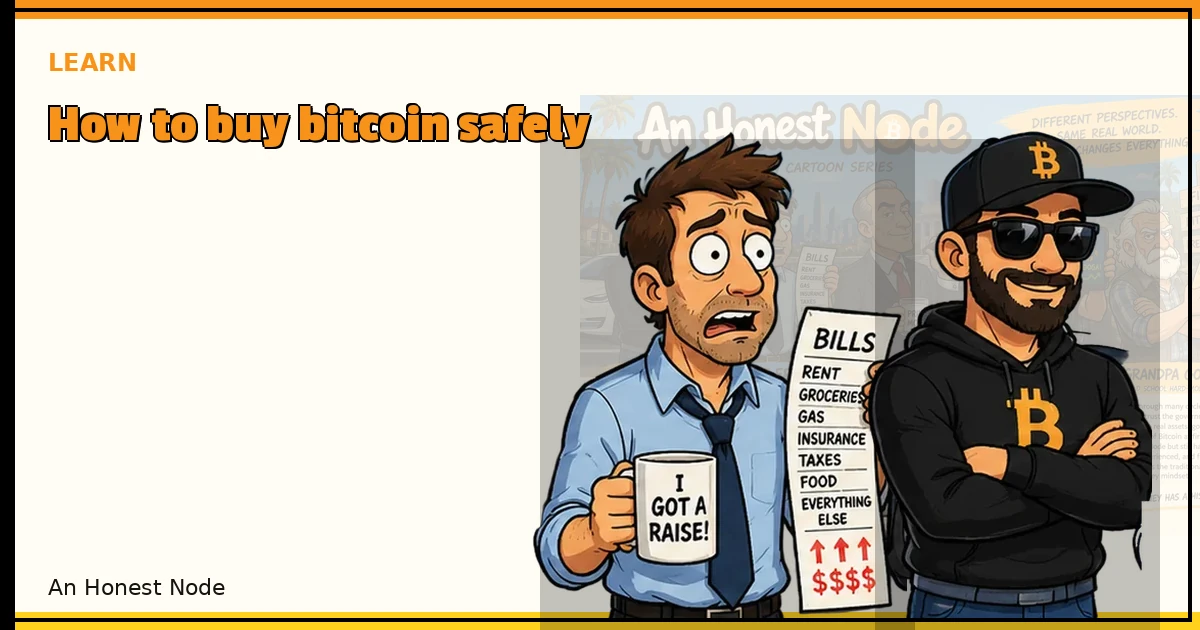
If the price itself is the reason you’re here, you’re not alone. In Episode 1 of the cartoon, “The Raise”, Fiat Frank gets a 5% raise, and then his rent goes up 7%. That feeling is why a lot of people go looking for their first bitcoin.
The first-buy checklist
Step 1: pick where to buy
For a first buy, use a well-known app that focuses on bitcoin. Apps that list hundreds of coins aren’t unsafe by themselves, but a screen full of tokens, games and promotions makes it easier to buy something you didn’t mean to.
- First pick: Strike This is my referral link. If you sign up, I may earn a reward at no cost to you. is a bitcoin-focused app for buying, recurring buys and sending bitcoin out (strike.me).
- Also bitcoin-focused: River This is my referral link. If you sign up, I may earn a reward at no cost to you. offers recurring buys, interest on cash and a public Proof of Reserves page (river.com).
- Widely available option: Coinbase This is my referral link. If you sign up, I may earn a reward at no cost to you. is fine if that’s what you can use or what your friends use. It isn’t bitcoin-only, so double-check that you’re buying BTC.
Comparing the two bitcoin-focused apps? Our Strike vs River guide goes through fees, recurring buys, withdrawals and Proof of Reserves side by side.
One trap to know: a listing in FinCEN’s MSB registrant search is not a safety check. FinCEN warns that scammers register as money services businesses too, then claim to be “approved by FinCEN” to look legitimate, and that registration is not an approval (FinCEN alert, Dec 2024). Stick with a company you found yourself, not one a stranger pointed you to.
Ways to buy, compared
| Way to buy | Do you own actual bitcoin? | Cost you can see | Scam risk |
|---|---|---|---|
| Bitcoin-focused app (Strike, River) | Yes, held by the company until you withdraw | Fee + spread shown before you confirm | Low if you secure the account and ignore DMs |
| Big multi-coin exchange (Coinbase) | Yes, held by the company until you withdraw | Fee + spread shown in the order preview | Low; more non-bitcoin products on screen |
| Spot bitcoin ETF in a brokerage | No, you own fund shares, not bitcoin | Fund fees; see the prospectus | No keys to manage, but you can’t withdraw coins |
| Bitcoin ATM (kiosk) | Yes, sent to the wallet you scan | Often high: FinCEN cites 7–20% fees | High: a favorite tool of scammers |
| A stranger, “mentor” or DM | Usually no: you just send them money | Unknown | Very high: treat it as a scam |
Sources: Strike fees, River fees, Coinbase fees and spread, SEC investor bulletin on bitcoin ETPs, FinCEN kiosk notice, FBI IC3. “Scam risk” is our plain-English summary of those sources, not a rating.
What about an ETF? A spot bitcoin ETF holds bitcoin for you, and the SEC notes it can spare you from handling keys yourself. But you own shares in a fund, not bitcoin, and you don’t directly own the bitcoin underneath (Investor.gov). The SEC also notes these products aren’t registered investment companies, so some fund protections don’t apply (SEC investor bulletin). You can’t withdraw ETF shares to your own wallet, so if what you want is bitcoin you can hold yourself, an ETF can’t give you that.
Steps 2–3: get the real app and lock it down first
- Get the app yourself. Type the company’s address or use the official app store listing. The FBI has warned that criminals buy search-engine ads that imitate real financial sites (FBI IC3), so don’t click a sponsored result to find a money app.
- Use a unique password for the app and for the email address tied to it. CISA’s example of an account takeover started with a hacked email that opened the door to linked bank and shopping accounts (CISA).
- Turn on two-factor authentication (2FA) before you add money. CISA says any MFA is better than none, and that phishing-resistant methods are the strongest (CISA). If the app offers an authenticator app or a security key, use that over text-message codes.
- Do identity checks only inside the app. If an app asks for ID, upload it in the app itself. Never send ID photos or login codes to anyone by DM, email or phone.
Steps 4–5: start small and read the real cost
Most apps show two costs. The trading fee is the line item. The spread is built into the price: it’s the difference between the market midpoint and the price you actually trade at. Strike explains that the spread is already in the buy price you see and can widen a lot when markets are jumpy (Strike). Coinbase says its simple buy orders include a spread and that you can see it, along with fees, on the order preview screen before you submit (Coinbase). River publishes its fee table and fee-free paths for recurring buys (River).
Fees change, so we don’t quote them here. The honest comparison is simple: put the same dollar amount and the same payment method into each app, then compare how much bitcoin you would receive. Coinbase notes that fees can depend on the payment method you pick (Coinbase), and some funding methods come with a wait before you can withdraw, so read the preview screen and the funding details before you confirm.
Then start small. Buy an amount you’d be fine learning with. You’ll see how the price moves, where the bitcoin shows up, and how the app works, before anything bigger is on the line. Recurring buys (dollar-cost averaging) are an option once you’re comfortable; Strike and River both publish fee-free rules for recurring buys after an initial period (Strike, River).
Step 6: red flags that mean stop
A common way people lose money while “buying bitcoin” isn’t a hack. It’s being talked into sending it. Stop if any of these happen:
- Someone tells you to go to a Bitcoin ATM and scan a QR code they sent. The FBI’s IC3 received more than 13,400 complaints involving crypto kiosks in 2025, with losses over $388 million, and says no legitimate government or law enforcement official will call to demand payment through one (FBI IC3). FinCEN also notes kiosk fees ranging from 7% to 20%, and that kiosk payments are hard to reverse (FinCEN).
- Someone you met online offers to “help you buy” or set up an account for you. The IC3 says not to send payment to someone you’ve only spoken to online (FBI IC3).
- “Support” reaches out first by DM, text or phone. Contact the company yourself through its app or official site.
- Anyone asks for your seed words (the 12, 20 or 24 recovery words). No real app, support agent or government agency needs them. Ever.
- A platform brags that it’s “approved by FinCEN.” FinCEN says MSB registration is not an approval, and that scammers use this exact claim (FinCEN).
- A letter asks you to “register” your crypto. The IRS warns about a scam letter with a QR code pushing a “Digital Assets Compliance Portal”; it says it doesn’t require registration of digital assets (IRS).
More scam types, and what to do if it already happened, are in Bitcoin scams to know in 2026.
Step 7: when it matters, move it to a wallet you control
While bitcoin sits in an app, the company holds the keys. The SEC’s custody bulletin puts the trade-off plainly: with self-custody you have sole control, and sole responsibility, for the keys and the backup (SEC). Keeping a starter amount on an app while you learn is fine. Real bitcoin on an exchange is still real bitcoin. When the amount starts to matter to you, move it:
- Set up a hardware wallet bought directly from the maker or an authorized reseller.
- Write the recovery words on paper or metal. Never a photo, never the cloud.
- Send a small test amount first. Check the receive address on the device’s own screen, then send the rest (Trezor).
Not sure which device? The beginner hardware wallet guide compares five bitcoin-only picks, and the move guide walks through the first withdrawal step by step. Already have a wallet? Run it through the Is My Wallet Safe? check.
If you’re leaning Trezor, the Trezor Safe 3 Bitcoin-only and Trezor Safe 5 Bitcoin-only are our usual beginner suggestions (affiliate links), and our Safe 3 vs Safe 5 vs Safe 7 comparison explains the differences from Trezor’s own specs. Buy from Trezor’s store or a reseller Trezor lists (Trezor). Prices and availability may change. Check Trezor’s site for current pricing.
Step 8: keep records and write a plan
Keep the purchase confirmations: date, amount, and what you paid. The IRS treats digital assets as property and asks you to keep records of purchases and sales. Its page also says that if you only bought bitcoin with dollars and didn’t sell, you answer “No” to the digital asset question on your return, and that moving coins between your own wallets doesn’t change that answer unless you paid the transfer fee in bitcoin (IRS). For cost basis and the new broker forms, see Form 1099-DA and your cost basis. This isn’t tax advice; talk to a tax pro about your situation.
Last step, and the one almost everyone skips: write down how your family would find and recover your bitcoin if something happened to you. The free Bitcoin Inheritance Kit walks you through it on printable pages, without ever writing your seed words into it.
What this guide can’t tell you
- Which app will quote you the best price today. Check the live preview in each one.
- Whether a company or feature is available in your state or country. Eligibility changes.
- Sign-up bonuses or exact fees. Those change, so we don’t list them.
- Tax, legal or investment advice for your situation.
Brand new to bitcoin itself? Start with Bitcoin basics: start here.
FAQ
What is the safest way to buy bitcoin for the first time?
Use a well-known, bitcoin-focused app you downloaded yourself from the official site or app store, set a unique password and turn on two-factor authentication before adding money, buy a small amount first, and read the fee and spread on the preview screen. Never buy through a stranger, a DM or a Bitcoin ATM someone sent you to.
Why is the bitcoin buy price higher than the price on the chart?
That gap is the spread: the difference between the market midpoint and the price you actually trade at. Apps build it into the quoted price, and some also charge a separate trading fee. Coinbase says you can see the spread and fees on the order preview screen. To compare apps, check how much bitcoin you would receive for the same dollar amount and payment method.
Source: Coinbase pricing and fees
Are Bitcoin ATMs safe to use?
The machines are a favorite tool of scammers. The FBI’s IC3 received more than 13,400 complaints involving crypto kiosks in 2025, with losses over $388 million, and FinCEN notes kiosk fees ranging from 7% to 20%. If anyone tells you to go to a Bitcoin ATM and scan a QR code they sent, stop: it is a scam.
Source: FBI IC3 kiosk data (May 2026)
Should I buy a bitcoin ETF instead of real bitcoin?
An ETF can spare you from handling keys, but you own shares in a fund, not bitcoin, and you can’t withdraw it to your own wallet. The SEC also notes spot bitcoin ETPs are not registered investment companies, so some fund protections don’t apply. If what you want is bitcoin you can hold and withdraw yourself, an ETF can’t give you that. This isn’t financial advice.
Do I need a hardware wallet before my first bitcoin purchase?
No. Many people make their first buy in an app and learn there. While it sits in the app, the company holds the keys. When the amount starts to matter to you, move it to a hardware wallet bought from the maker, write the recovery words on paper or metal, and send a small test amount first.
Source: SEC crypto custody basics
Related
Strike vs River: two bitcoin-focused ways to buy
Fees, recurring buys, withdrawals and Proof of Reserves, side by side.
Best bitcoin hardware wallet for beginners: 5 bitcoin-only picks, honestly compared
After you buy: pick a first device and buy it from the maker.
Bitcoin scams to know in 2026 (and how to avoid them)
ATM demands, fake support, fake sites, and what to do if it happened.
Is My Wallet Safe? checker
Four questions, a plain-language verdict. Runs in your browser; nothing is sent.
Sources
- Strike — What are the trading fees? (fees and spread)
- Strike — Home
- River — Home
- River Help — What are River’s fees?
- Coinbase Help — Pricing and fees disclosures (spread, order preview)
- CISA — More than a Password (MFA)
- CISA — Turn On MFA
- FBI IC3 — Cybercriminals impersonating brands using search engine ads (Dec 2022)
- FBI IC3 — Cryptocurrency kiosk complaint data by state (May 15, 2026)
- FinCEN — Notice on CVC kiosks for scam payments (FIN-2025-NTC1, Aug 4, 2025)
- FinCEN — MSB Registrant Search
- FinCEN — Alert on fraud schemes abusing FinCEN’s name, incl. fake MSB “approval” claims (FIN-2024-Alert005, Dec 18, 2024)
- SEC Investor.gov — ETPs providing exposure to bitcoin and ether (investor bulletin)
- SEC Investor.gov — Crypto asset-related investments
- SEC Investor.gov — Crypto asset custody basics for retail investors (Dec 12, 2025)
- IRS — Digital assets
- Trezor — Trusted Display: verify every address on your device
- Trezor — Where to buy a genuine Trezor